
When to Break Your App Apart: A Senior Architect's Guide to Migrating from Monolith to Microservices
When the Monolith Becomes a Constraint
Most successful software companies build their first product as a monolith. This is correct. A monolith is simpler to build, simpler to deploy, simpler to debug, and simpler to reason about than a distributed system. The teams who start with microservices because they are "more scalable" typically spend their first two years fighting accidental complexity instead of building product.
But monoliths have scaling boundaries—both technical and organisational. When those boundaries start limiting your ability to ship product, recover from failures, or scale specific parts of your system independently, decomposition becomes worth the significant investment. The question is not whether to decompose, but when and how to do it without creating more problems than you solve.
The Six Warning Signs
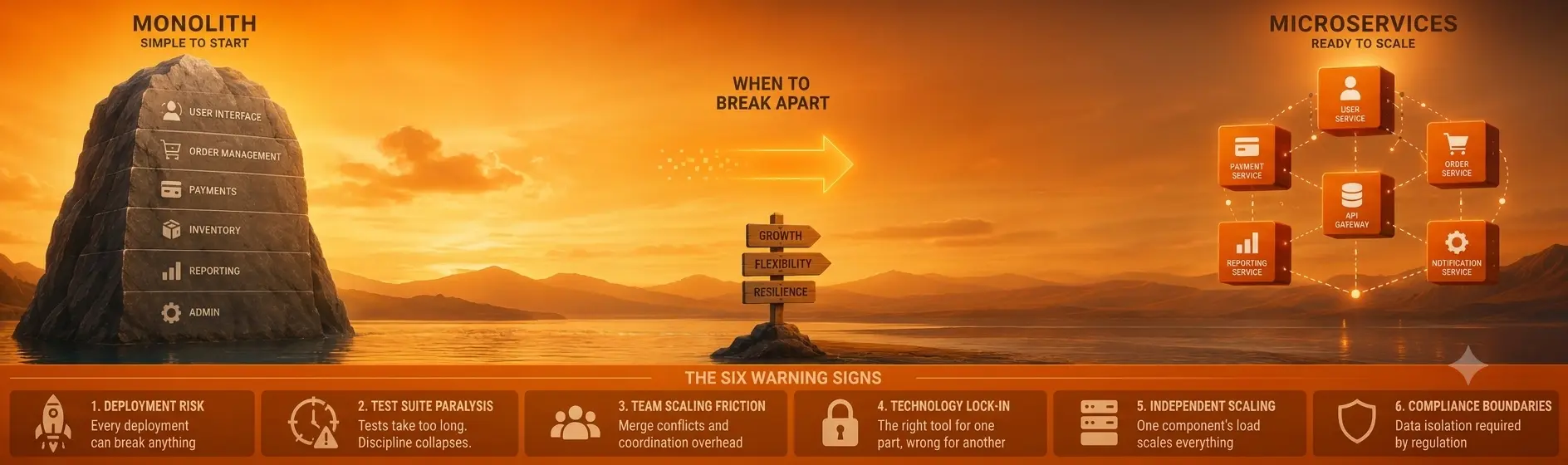
There are six symptoms that reliably indicate a monolith has outgrown its architecture:
- Deployment risk is compounding: Every deployment touches the entire application, so every deployment can break anything. Teams respond by deploying infrequently, which makes each deployment riskier. The cycle reinforces itself until deployments happen once a month—or less.
- Test suite paralysis: The full test suite takes 45+ minutes. Teams stop running it locally. Test discipline collapses. Regressions ship.
- Team scaling friction: Multiple teams working in the same codebase create constant merge conflicts and coordination overhead. A change by one team breaks something for another without warning.
- Technology lock-in at the wrong level: A specific component would benefit dramatically from a different language, database, or processing model, but the monolith forces a single technology choice across all concerns.
- Independent scaling needs: Your image processing service needs 8x more CPU than your user management service, but you are scaling the entire application uniformly to serve the load of one component.
- Compliance boundary requirements: GDPR, PCI-DSS, or HIPAA create a hard requirement for data isolation between components that cannot be achieved within a shared database monolith.
The Case Against Premature Decomposition
Before any migration discussion, it is worth being honest about the costs. A distributed system is fundamentally harder to operate than a monolith. Network calls fail. Distributed transactions are complex. Observability requires tooling that does not exist in a monolith context. On-call engineers deal with failure modes that simply do not exist in a single process.
If your team does not have strong operational foundations—monitoring, alerting, deployment automation, on-call processes, and a mature incident response culture—migrating to microservices will make all of your problems worse, not better. The prerequisite for microservices is not product success. It is engineering maturity.
The Staged Migration Strategy
The Strangler Fig pattern, popularised by Martin Fowler, remains the most reliable migration approach. Rather than attempting a "big bang" rewrite—which fails nearly every time—you incrementally extract services from the monolith, routing traffic to the new service while the old code path exists as a fallback.
The sequence that works reliably: first, identify clear seams in the existing monolith—bounded contexts where one domain's data and logic is clearly separable from another's. Second, build a lightweight API gateway or reverse proxy that can route requests to either the monolith or a new service. Third, extract the highest-value, lowest-risk service first—typically a component with clear boundaries, a stable API contract, and a small blast radius if something goes wrong. Fourth, run old and new implementations in parallel before cutting over, validating that outputs match. Fifth, once the new service is stable, remove the corresponding code from the monolith.
Service Boundaries and Team Alignment
Conway's Law is real: your system architecture will mirror your team structure. Define service boundaries before defining team boundaries, and use domain-driven design principles to identify where the natural seams are. Services that cross team ownership boundaries create coordination costs that eliminate the autonomy benefits you migrated to achieve.
Each service should be owned end-to-end by a single team: they define its API contract, manage its database, deploy it, and are on-call for it. Shared databases between services are the most common way microservices migrations fail—they preserve the coupling the migration was designed to eliminate, while adding all the complexity of a distributed system.
Realistic Timeline Expectations
A well-managed migration of a medium-size monolith—500,000 to 2 million lines of code—to a service-oriented architecture takes 18 to 36 months of sustained effort from a team of four to eight engineers, running in parallel with ongoing product development. Expectations of doing it significantly faster typically result in shortcuts that recreate the original coupling in a more expensive, distributed form.
The value is real, and for the right companies at the right scale, it is worth the investment. But it should be approached as the multi-year programme it is, with clear decision criteria at each stage for whether to continue, pause, or adjust the strategy based on what the team is learning.
If your architecture is limiting your growth, the right first step is an architectural assessment—not a migration plan. You need clarity on what you actually have, and where the genuine boundaries are, before you can design a reliable path forward. Let us design a reliable migration roadmap that fits your team, your timeline, and your risk tolerance.
Tags
Dinesh Soni
Founder & Lead Developer at Techmits — building digital solutions for businesses across India and globally.
Ready to Work Together?
Let's Build Something Great
Get a free consultation with our team and see how we can help grow your business digitally.
Start a Project