
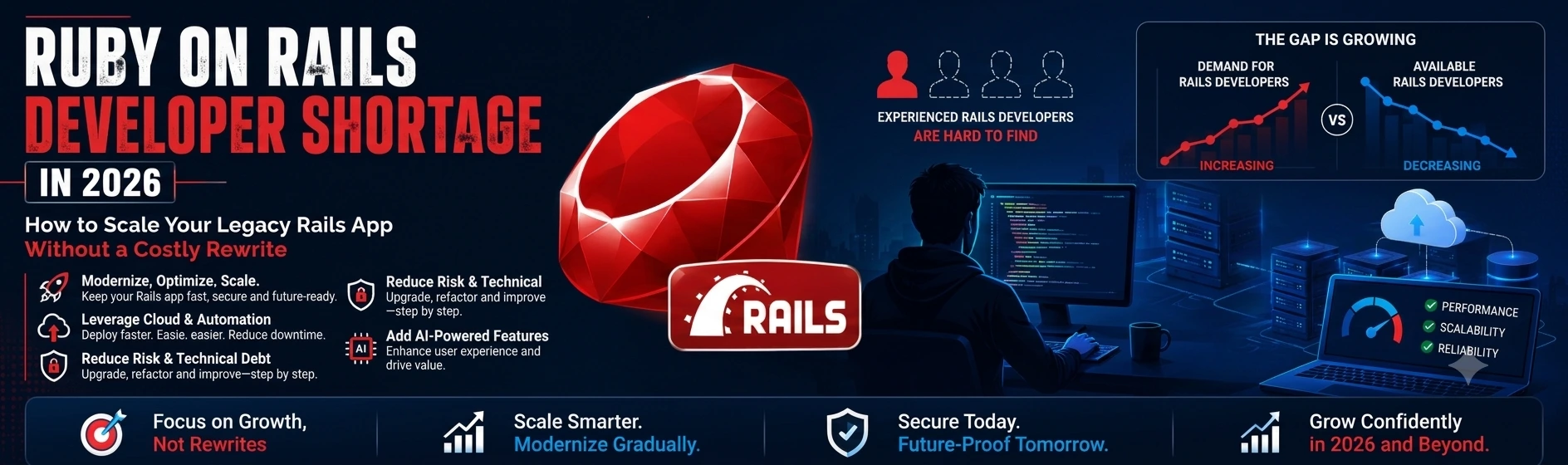
The Ruby on Rails Developer Shortage: How to Scale Your Legacy Rails App in 2026
The Rails Paradox
Ruby on Rails powers some of the most profitable web businesses in the world: GitHub, Shopify, Basecamp, and thousands of others. It is a mature, productive framework with a track record spanning more than 20 years. Yet in 2026, finding a senior Rails developer who can safely navigate a large, aging codebase is genuinely difficult—and finding one who is available at a rate a growing company can afford is nearly impossible.
The result is a growing number of companies trapped with mission-critical Rails applications they cannot safely change, cannot efficiently hire for, and cannot abandon without a multi-year, multi-million-pound migration project.
Why Senior Rails Expertise Is So Rare
Rails experienced its peak hiring wave between 2008 and 2016. The developers who learned it deeply during that period are now either senior technical leaders at large companies (unavailable), freelancers charging premium rates, or have transitioned to other languages. The pipeline of new Rails developers dried up as bootcamps shifted focus to JavaScript frameworks around 2017.
What remains is a large pool of developers who have used Rails but have not developed the deep intuition needed to safely refactor a 500,000-line application with five years of accumulated complexity.
The Four Dangers of a Stale Rails Codebase
- Security vulnerabilities from unpatched dependencies: Rails applications that have not been updated regularly accumulate gems with known CVEs. An unmaintained Rails 5 or 6 app running in production is a liability waiting to be exploited.
- Hiring friction: Strong developers will not join a company running a Rails version from four years ago. It signals technical debt they will spend their days fighting rather than building product.
- Performance ceiling: Older Rails versions lack modern query optimisations, connection pool improvements, and async processing capabilities that dramatically improve throughput under load.
- Integration risk: Modern payment processors, authentication providers, and third-party APIs drop support for older TLS versions and authentication patterns. An unmodernised codebase eventually loses access to critical integrations.
Safe Modernisation Without a Rewrite
The right approach to an aging Rails application is not to rewrite it in a newer framework. It is to modernise it incrementally, preserving the business logic that represents years of accumulated domain knowledge while upgrading the infrastructure layer underneath it.
A structured modernisation typically proceeds in three phases. First, a dependency and security audit establishes the current state. Second, an incremental upgrade path moves the application through Rails versions one major version at a time, with automated test coverage expanded at each step. Third, selective refactoring addresses the areas that create the most friction for new development.
What a Fractional Rails Architect Does Differently
A fractional senior Rails architect is not a staff augmentation hire. They are an experienced engineer who has navigated dozens of legacy modernisation projects, knows which shortcuts create problems six months later, and can compress a year of cautious internal work into three months of focused intervention.
Critically, they produce something most legacy codebases lack: comprehensive documentation of the non-obvious decisions baked into the system, making it possible to hire and onboard mid-level developers effectively. Hire a fractional senior Rails architect and get your codebase back to an asset.
Tags
Dinesh Soni
Founder & Lead Developer at Techmits — building digital solutions for businesses across India and globally.
Ready to Work Together?
Let's Build Something Great
Get a free consultation with our team and see how we can help grow your business digitally.
Start a Project