
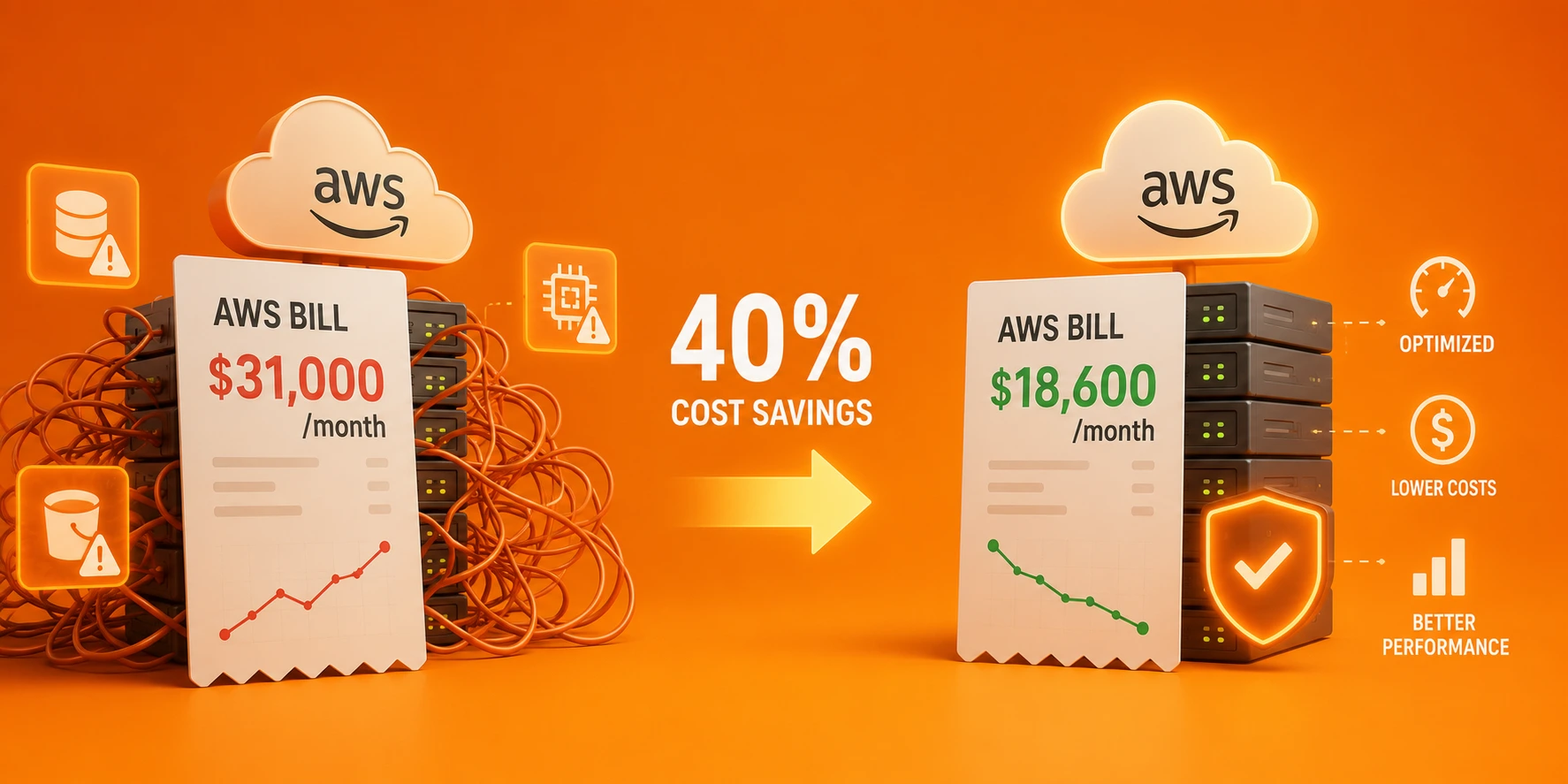
How We Slashed an Enterprise AWS Bill by 40% Without Changing Their Product
The Bill That Shocked a CTO
In early 2025, we received an enquiry from a Series A SaaS company whose AWS bill had grown from $8,000 to $31,000 per month over twelve months—despite user growth of only 40%. Their CTO, who had joined three months earlier, had been tasked with explaining the discrepancy to the board. He could not.
We audited their infrastructure over two weeks. We found no runaway services. No cryptomining. What we found was something more mundane and far more common: 23 separate backend inefficiencies, each costing between $100 and $1,800 per month, that had accumulated invisibly as the engineering team focused on features rather than infrastructure hygiene. Combined, they accounted for $14,200 in avoidable monthly spend.
Why Cloud Bills Grow Faster Than Usage
Cloud infrastructure scales automatically—which is a feature when demand is genuine, and a problem when demand is inflated by inefficient code. Slow database queries hold connections open longer, requiring more database instances. Missing caches cause repeated computation. Unoptimised background jobs require ten times the worker instances to maintain throughput. The cloud charges for all of it. Infrastructure teams respond by scaling up. Engineers ship more features. The cycle continues until someone with a cross-cutting view of both code and infrastructure finds the actual root causes.
The Five Optimisations That Delivered 40% Savings
Query Optimisation and Index Strategy
Adding five composite indexes and rewriting three analytical queries reduced their RDS instance requirement from db.r6g.xlarge to db.t4g.medium—saving $890 per month on database costs alone. Query execution time on the most expensive endpoints dropped by 94%.
Redis Caching Layer
Their API was recomputing the same expensive aggregations on every request. Adding targeted Redis caching eliminated 78% of their computational load, reducing their application server fleet from 12 instances to 4. The ElastiCache cost was $180 per month. The compute saving was $4,100 per month.
Background Job Architecture
Email processing, report generation, and third-party sync jobs were running synchronously in the web process. Moving them to dedicated workers eliminated the timeout-related failures that had been forcing customer-facing retries—each of which was re-executing the same expensive operation.
Instance Right-Sizing
With efficiency improvements in place, actual compute requirements were benchmarked under production load. They were running instances 3x larger than needed. Downsizing delivered $4,200 in monthly savings directly.
CloudFront and Static Asset Optimisation
Static assets were being served from S3 with no CDN and no compression. Adding CloudFront with brotli compression reduced S3 GET request count by 91% and improved global load times simultaneously.
The Lesson
The combined result was a reduction from $31,000 to $18,400 per month—a 40.6% saving. Cloud cost reduction is not primarily an infrastructure problem. It is a backend engineering problem. Schedule a cloud infrastructure review and find out exactly where the money is going.
Tags
Dinesh Soni
Founder & Lead Developer at Techmits — building digital solutions for businesses across India and globally.
Ready to Work Together?
Let's Build Something Great
Get a free consultation with our team and see how we can help grow your business digitally.
Start a Project